

For Schools

Practical money lessons for your school

Give pupils a chance to practise the money decisions they’ll face outside school, from earning their first pay to budgeting for life away from home.

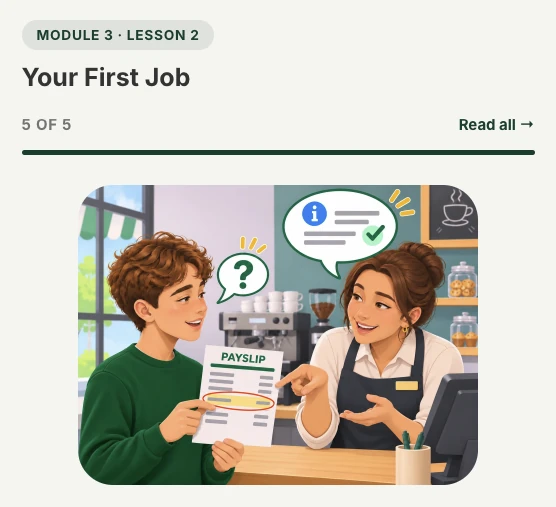
A young worker in a café asks a colleague about a deduction on their payslip.
Inside a Grandy lesson Your First Job · Payslips

Find the right bundle for your school

Use these bundles in PSHE or Citizenship lessons, or as part of Careers Week or Enterprise Week. If you need a single lesson or a longer programme, we can help you choose.

Moving Out + Off to Uni

Help pupils budget for rent and bills, and plan for the everyday costs of university.

View bundleHide bundle: Moving Out + Off to Uni

What pupils will learn

  • Moving Out: Work out what they can afford before signing a tenancy agreement, including the deposit, rent and bills.
  • Off to Uni: See how student finance fits into a budget and plan for everyday costs while studying.

Suggested lessons: Housing and Independent Living (M15) + Student Finance and Big Decisions (M16)

Request a quote for this bundle

My First Paycheque

Help pupils explore ways to earn and check their first payslip.

View bundleHide bundle: My First Paycheque

What pupils will learn

  • Explore different ways to earn money.
  • Understand payslip deductions and work out what to do if their pay doesn’t look right.

Suggested lessons: Getting Paid (M3)

Request a quote for this bundle

Make Your Money Go Further

Help pupils compare prices, stick to a budget and set a savings goal.

View bundleHide bundle: Make Your Money Go Further

What pupils will learn

  • Compare prices and decide what to buy with a £20 party budget.
  • Set a savings goal.

Suggested lessons: Spending Smart (M5) and Saving and Goals (M6)

Request a quote for this bundle

Before You Borrow

Help pupils compare borrowing costs and spot common money traps.

View bundleHide bundle: Before You Borrow

What pupils will learn

  • Compare the costs of borrowing and think through what happens if they miss a repayment.
  • Spot common money traps.

Suggested lessons: Credit and Borrowing (M7) and Dangerous Money Traps (M8)

Request a quote for this bundle

Tell us your year group and how much time you have. Choose one or more bundles in the form.

Request a school quote

From one topic to a longer programme

Pupils can work through online lessons independently, or you can use them as part of a teacher-led session.

Single module
Focus on one topic, such as getting paid.
Event bundle
Pair topics for a themed week or a transition event.
School programme
Plan a sequence of modules across your timetable.

How to book: Share your year group, pupil numbers and dates. We’ll recommend lessons and send a quote that sets out the resources and access dates. If you decide to go ahead, we’ll invoice your school and arrange access.

Money lessons at Stockwell Primary

In five teacher-led Grandy lessons, pupils explored the difference between needs and wants, spotted sales tactics and practised judging value for money by comparing the price of something with how much they’d use it.

Same questions before and after the lessons

53%

48 pupils took the quiz

83%

44 pupils took the quiz

55 pupils enrolled. These are group averages, not changes in individual pupils’ scores.

Money decisions beyond the classroom

A Year 5 teacher noticed that pupils could still recall what they had learned days later. On a school trip, pupils pointed out adverts and discussed which things they thought were worth buying and which were not.

“I think it all worked really well together and the unit was pitched perfectly for Year 5”

Alice, Year 5 teacher

Explore school bundles 

From first money habits to independent living

Expand the pathways below to see what each module covers. We’ll confirm which modules are available for your cohort and can share detailed curriculum mapping on request.

Download the full curriculum overview (PDF) 
Grandy RootsPrimary · Years 5–6 · R1–R3
  • R1
    What Is Money and Why Does It Matter

    What money does and the difference between needs and wants.

  • R2
    Earning and Spending

    Where money comes from, and how price and value differ.

  • R3
    Saving and Goals

    Why people save and how to set a first savings goal.

Main curriculumSecondary and sixth form · Years 7–13 · M1–M18

Core

  • M1
    What Is Money?

    What money is and how it moves.

  • M2
    The Psychology of Money

    How feelings and habits shape money choices.

  • M3
    Getting Paid

    Ways to earn, first jobs, tax and rights at work.

  • M4
    Banking Basics

    Accounts, payments and keeping money safe.

  • M5
    Spending Smart

    Comparing costs, spotting value and spending with a plan.

  • M6
    Saving and Goals

    Setting goals and building a habit of saving.

Launch

  • M7
    Credit and Borrowing

    How borrowing works and what it costs.

  • M8
    Dangerous Money Traps

    Spotting scams and other costly traps.

  • M9
    Your Rights and Protections

    What protects consumers and where to turn for help.

  • M10
    The System

    How the financial system shapes people’s choices.

  • M11
    Community and Diaspora Finance

    How communities save, share and send money.

  • M12
    Work, Tax, and Your Rights

    Pay, tax and protections at work.

Accelerator

  • M13
    Wealth Building Fundamentals

    Long-term saving, compounding and risk.

  • M14
    Advanced Investing and Pensions

    Investment choices and planning for retirement.

  • M15
    Housing and Independent Living

    Rent, deposits and the cost of living independently.

  • M16
    Student Finance and Big Decisions

    Student funding and the costs of life after school.

  • M17
    Entrepreneurship and Business

    Starting a business and making decisions about price and costs.

  • M18
    The AI Economy and Your Grand Life

    How AI is changing work and what that means for money decisions.

Starting in Year 7? The framework also includes a Foundation bridge: Money Basics (F1), Earning and Spending (F2), and Saving and Goals (F3). Ask us which route suits your pupils.

Bring Grandy to your school

Prefer to get in touch directly? Email schools@grandy.app or call 020 8090 8451. Please don’t include pupil names or personal details. Website privacy notice.

Ask for a school quote